What is an ACH payment and how an ACH transfer works

Comet Cash Team
•
Dec 11, 2025

ACH payments are electronic money transfers processed through the U.S. Automated Clearing House (ACH) network. This system connects banks and credit unions, enabling secure and efficient transactions like direct deposits, bill payments, and peer-to-peer transfers. In 2024, the ACH network processed 33.6 billion payments worth $86.2 trillion, highlighting its role in everyday financial activities.
Key Points:
Types of ACH Transactions:
ACH Credit: Push payments (e.g., payroll, tax refunds).
ACH Debit: Pull payments (e.g., bill payments, subscriptions).
Processing Time: Standard transfers take 1–3 business days, while Same-Day ACH settles within hours.
Benefits: Lower costs, automation, and enhanced security compared to checks or wire transfers.
Challenges: Delays on weekends/holidays, potential for errors, and limitations with international transfers.
ACH payments are widely used by individuals, businesses, and fintech platforms for their reliability and cost-effectiveness. However, understanding the process, ensuring correct details, and following security practices are essential for smooth transactions.
Types of ACH Transactions
ACH Credit vs. ACH Debit
ACH transactions are divided into two main types: credits (push payments) and debits (pull payments).
An ACH credit is a "push" payment where the sender initiates the transfer and deposits money into the recipient's account. Think of an employer directly depositing a paycheck into an employee's bank account - that's an ACH credit in action. Other examples include tax refunds and vendor payouts. In 2024, the ACH Network handled an impressive 8.6 billion direct deposits, with nearly 93% of American workers receiving their paychecks this way.
On the other hand, an ACH debit is a "pull" payment. Here, the recipient initiates the transaction and withdraws funds from the sender's account, but only after receiving authorization. Recurring payments like mortgages, utility bills, and subscription services are typical examples. In 2024, consumers completed 16.38 billion bill payments and transfers through ACH.
To better grasp how these processes work, it helps to understand the terminology behind ACH transactions.
Key ACH Terms
Here are some essential terms to know when it comes to ACH transactions:
Originator: The entity or individual initiating the ACH transaction.
ODFI (Originating Depository Financial Institution): The financial institution that receives the payment instructions from the originator and submits them to the ACH network.
RDFI (Receiving Depository Financial Institution): The recipient's financial institution, responsible for posting the transaction to the account holder's account.
ACH Operators: Entities like the Federal Reserve and The Electronic Payments Network (EPN) that sort and route transactions between banks.
Nacha: The organization that oversees the ACH network, setting the rules and standards all participants must follow.
Terms like direct deposit and direct debit are often used to describe ACH credits and debits, respectively.
Common Uses for ACH Payments
ACH transactions play a significant role in everyday financial activities.
For individuals, ACH payments make payroll deposits, government benefits, and tax refunds seamless. For instance, 99% of Social Security payments are processed via ACH, and by 2025, 90.6% of Americans are expected to choose ACH for tax refunds. ACH also supports recurring payments for utilities, subscriptions, and loans, as well as peer-to-peer transfers through digital wallets.
Businesses rely on ACH for payroll distribution, vendor payments, and business-to-business transactions. In 2024, companies processed 7.3 billion B2B payments via ACH, marking an 11.6% increase compared to 2023. Additionally, ACH debits are widely used by businesses to collect recurring payments for services, insurance premiums, and loan repayments.
What is ACH Transfer / ACH Payment? A Simple Explanation for Beginners
How ACH Transfers Work
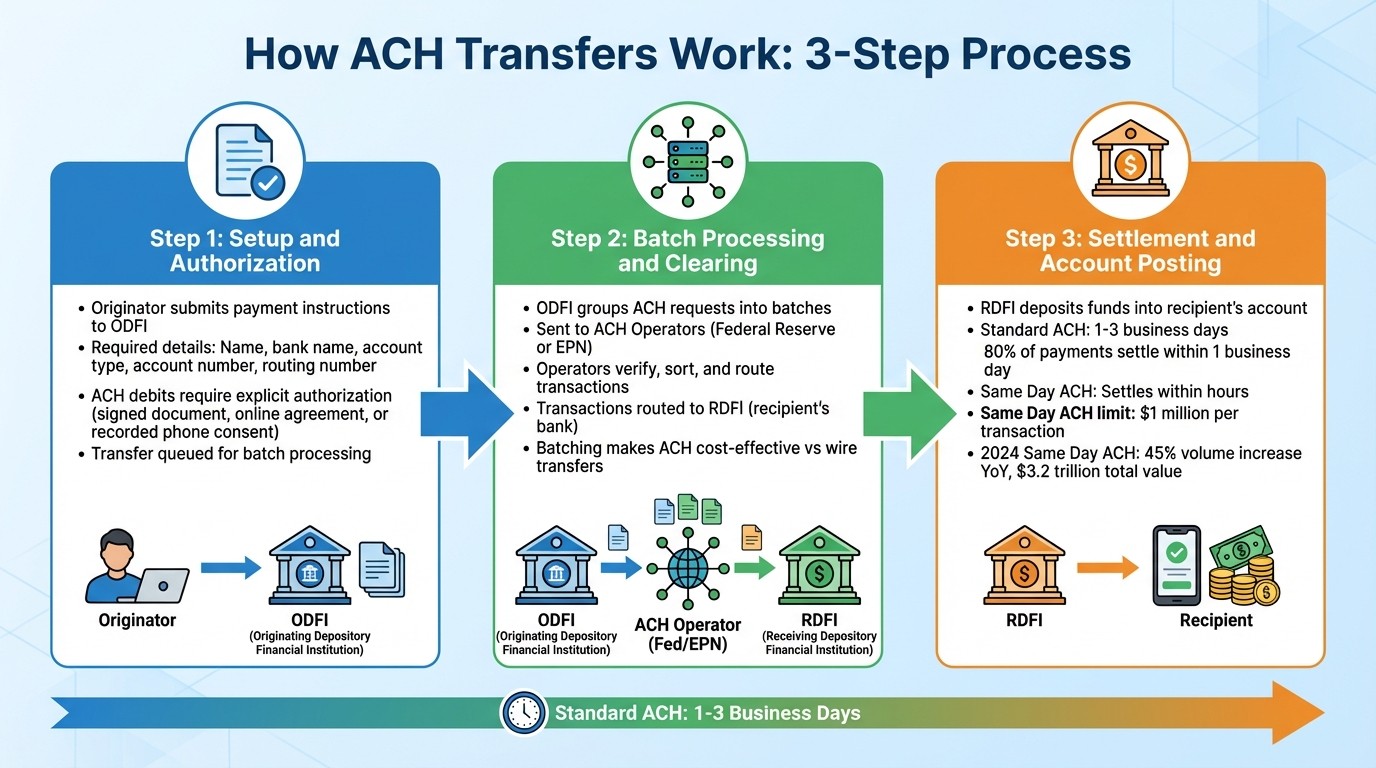
How ACH Transfer Works: 3-Step Process from Authorization to Settlement
Step 1: Setup and Authorization
An ACH transfer kicks off when an Originator - whether that's you, your employer, or a utility company - submits payment instructions to its bank, known as the Originating Depository Financial Institution (ODFI). To get started, you'll need some key details about the recipient: their name, bank name, account type, account number, and routing number.
For ACH debits, explicit authorization is a must. This could be a signed document, an online agreement, or even recorded phone consent. Once authorization is in place, the transfer gets queued up for batch processing.
Step 2: Batch Processing and Clearing
After the ODFI receives the payment instructions, it groups ACH requests into batches and sends them to an ACH Operator on a set schedule. In the U.S., there are two main ACH Operators: the Federal Reserve and The Clearing House's Electronic Payments Network (EPN). These operators play a critical role by verifying the information in the batches, sorting transactions by their destination, and routing them to the appropriate Receiving Depository Financial Institutions (RDFIs) - the banks where the recipients hold accounts. This batching system is what makes ACH transfers more cost-effective compared to wire transfers. Once the transactions are cleared, they move into the settlement phase.
Step 3: Settlement and Account Posting
The RDFI processes the payment files and deposits the funds into the recipient's account. Standard ACH transfers generally take 1–3 business days to complete, but around 80% of payments settle within one business day or less. For faster processing, Same Day ACH is an option, settling funds within hours as long as the transfer is submitted before the cutoff time. However, Same Day ACH comes with a $1 million transaction limit and higher fees. In 2024, Same Day ACH saw a 45% increase in volume year-over-year, handling a total of $3.2 trillion in value.
"It's imperative to know your payment provider's cut-off times for same-day and next-day ACH so you can appropriately route to the rail that will help you meet the expected date for settlement of funds."
Tyler Nappy, Product Manager, Plaid
Timing is everything. If you miss your bank's cutoff time or initiate a transfer on a weekend or holiday, processing will be delayed until the next business day. Additionally, issues like incorrect account details or insufficient funds can cause further delays in processing.
How Different Users Apply ACH Payments
ACH payments play a crucial role in the financial lives of individuals, businesses, and fintech platforms, offering a reliable and efficient way to manage transactions.
For Individuals
ACH payments are woven into the daily routines of most Americans. A whopping 93% of Americans receive their paychecks through direct deposit, which is essentially an ACH credit. But it doesn’t stop there - ACH also powers government payments like Social Security, tax refunds, and unemployment benefits. On the spending side, ACH debits make automatic bill payments a breeze, covering everything from utilities and mortgages to insurance premiums and subscriptions.
Need to move money between your own accounts or top up your digital wallet? ACH has you covered. Its appeal lies in being cost-effective - often free or low-cost - and reliable. Unlike credit cards that expire every few years, bank accounts typically last much longer (an average of 14 years), reducing the chance of missed payments.
For Businesses
ACH payments aren’t just for personal use - businesses depend on them for their scalability and affordability. For payroll, ACH is a game-changer, enabling companies to pay hundreds or even thousands of employees in one go, eliminating the hassle of issuing paper checks. Vendor payments are also streamlined, allowing businesses to manage cash flow effectively by scheduling payments on specific dates.
Security is another major draw. ACH transactions are encrypted and adhere to strict regulations, making them far safer than paper checks, which are vulnerable to theft, loss, or tampering.
For Fintech Platforms
For fintech companies, ACH is the backbone of many services, including payroll automation, subscription billing, and funding digital wallets. Leading digital wallet platforms rely on ACH to let users seamlessly add or withdraw funds.
Thanks to modern APIs and open banking, integrating ACH has never been easier. Fintechs can now verify accounts, evaluate risks, and process payments with tools designed to handle everything from authorization to fraud detection. This level of functionality allows fintech platforms to provide smooth, secure, and efficient user experiences.
Benefits, Limitations, and Risk Management
Benefits of ACH Payments
ACH payments offer a cost-effective solution for payroll and vendor transactions by cutting down on fees and administrative tasks compared to paper checks, credit cards, or wire transfers. Automation plays a big role here, making recurring payments - like monthly subscriptions, utility bills, or employee salaries - easier to manage while reducing manual errors.
Security is another advantage. ACH transactions are encrypted and follow Nacha's strict guidelines to protect sensitive banking information. Unlike paper checks, which can be lost, stolen, or tampered with, ACH payments significantly lower the risk of fraud. Plus, if an error occurs, it can be corrected within five business days, unlike wire transfers, which are final once processed. Businesses benefit from predictable payment schedules that improve cash flow, while individuals enjoy the ease of direct deposits and automatic bill payments, helping them avoid late fees.
Limitations of ACH Payments
While ACH payments have their perks, they’re not perfect. One downside is the slower processing time compared to instant transfers, which can delay urgent payments. ACH systems also don’t operate on weekends or federal holidays, potentially causing further delays.
Another challenge is the potential for penalty fees. Payments can be rejected due to errors or insufficient funds, and businesses must maintain a return rate below Nacha's 15% threshold for ACH debits to avoid fines. Additionally, ACH transactions lack immediate finality, as they can be returned as "unauthorized" for up to 60 days after settlement. Standard ACH payments are also limited to U.S. bank accounts, and handling International ACH Transactions often involves extra compliance steps and higher costs.
These limitations highlight the need for solid risk management practices.
Risk Management and Security Practices
To navigate potential risks and delays, businesses must adopt strong risk management strategies. Compliance with Nacha's evolving rules is key. For example, starting March 20, 2026, large payment originators and service providers will need to implement fraud monitoring systems, with these requirements extending to all non-consumer participants by June 22, 2026.
Account verification is a must. Confirming account and routing numbers before initiating payments reduces errors and helps prevent fraud. Proper authorization is also critical - whether through written agreements or Nacha-compliant digital approvals for ACH debits, this step minimizes disputes.
Fraud monitoring tools, like real-time risk scoring systems, can enhance security. Clear workflows for managing failed transactions are equally essential. Remember, unauthorized returns can occur up to 60 days after settlement, making it crucial to maintain thorough documentation and encrypt sensitive data. These aren’t just best practices - they’re requirements.
Conclusion
ACH payments have become a cornerstone of electronic banking in the United States, processing a staggering 33.6 billion transactions worth $86.2 trillion in 2024 alone. Their role in modern finance is undeniable, offering businesses a cost-effective alternative to credit card transactions.
For businesses, understanding the ACH process - whether it's setting up direct deposits, automating bill payments, or managing payroll - ensures smoother operations and realistic expectations. The system's ability to handle recurring and high-volume payments at lower costs makes it an essential tool for financial efficiency.
The rise of Same-Day ACH highlights how the network continues to adapt to evolving needs. While it may not support instant transfers, it remains the preferred choice for transactions where affordability and reliability matter most.
Ultimately, success with ACH payments depends on proper setup and strong security measures. By leveraging these advantages, businesses can streamline their financial operations while keeping costs in check. It's clear that ACH payments are here to stay, providing a dependable and cost-efficient solution in the ever-evolving world of electronic banking.
FAQs
What are the differences between ACH payments and wire transfers in terms of cost and speed?
Wire transfers are known for their speed, often completing within minutes or by the end of the same business day. However, this convenience comes at a price, with fees sometimes reaching $50 per transfer. In contrast, ACH payments take longer - typically 1-3 business days to process - but are much easier on the wallet, often costing little to nothing.
For everyday needs like payroll or recurring bill payments, ACH transfers are a budget-friendly option. But when time is of the essence or you’re dealing with a large sum, the quicker processing of wire transfers might justify the higher cost.
How are ACH payments kept secure?
ACH payments come with robust security measures to keep your information safe. Transactions are encrypted both during transfer and while stored, ensuring data remains protected. Strict access controls are enforced to block any unauthorized access, and banks and payment providers rely on multi-factor authentication alongside advanced fraud detection systems to spot and address unusual activity.
On top of that, ACH payments adhere to NACHA rules, which establish stringent guidelines for data security and transaction processes. These safeguards work together to protect sensitive information and uphold confidence in the ACH network for individuals and businesses alike.
Can ACH payments be used for sending money internationally?
ACH payments are specifically tailored for transactions within the United States and its territories. They allow electronic transfers between U.S. bank accounts, commonly used for tasks like direct deposits, bill payments, and business-related transfers.
However, ACH is not equipped for cross-border payments. If you need to send money internationally, you'll have to rely on alternatives such as wire transfers.