
What is A SEPA payment is and how SEPA transfers works

Comet Cash Team
•
Dec 12, 2025

SEPA (Single Euro Payments Area) simplifies euro payments across 36 countries by standardizing rules and processes, making cross-border transactions as easy as domestic ones. Whether you're paying suppliers, employees, or handling recurring bills, SEPA ensures faster, secure, and cost-effective transfers with minimal bank fees. Key points:
Types of Transfers:
SEPA Credit Transfer (SCT): 1 business day for processing.
SEPA Instant Credit Transfer (SCT Inst): Under 10 seconds, 24/7 availability.
SEPA Direct Debit Core: For recurring payments, takes 2–3 business days.
SEPA Direct Debit B2B: For business-to-business payments, processes in 1–3 business days.
Key Features:
Standardized use of IBAN and BIC for accuracy.
Equal fees for domestic and cross-border euro payments.
High security under the Payment Services Directive (PSD2).
Limits:
SCT: Up to €999,999,999.99.
SCT Inst: €100,000 per transaction (may vary by bank).
Coverage: Includes EU countries, plus others like the UK, Norway, and Switzerland.
SEPA also integrates with Bitcoin and Lightning Network systems, allowing businesses to link euro accounts with cryptocurrency operations for efficient payments. Tools like Comet Cash automate these processes, streamlining workflows between traditional banking and digital assets.
SEPA Uncovered: A Comprehensive Guide to the Single Euro Payments Area
SEPA Payment Schemes and Types
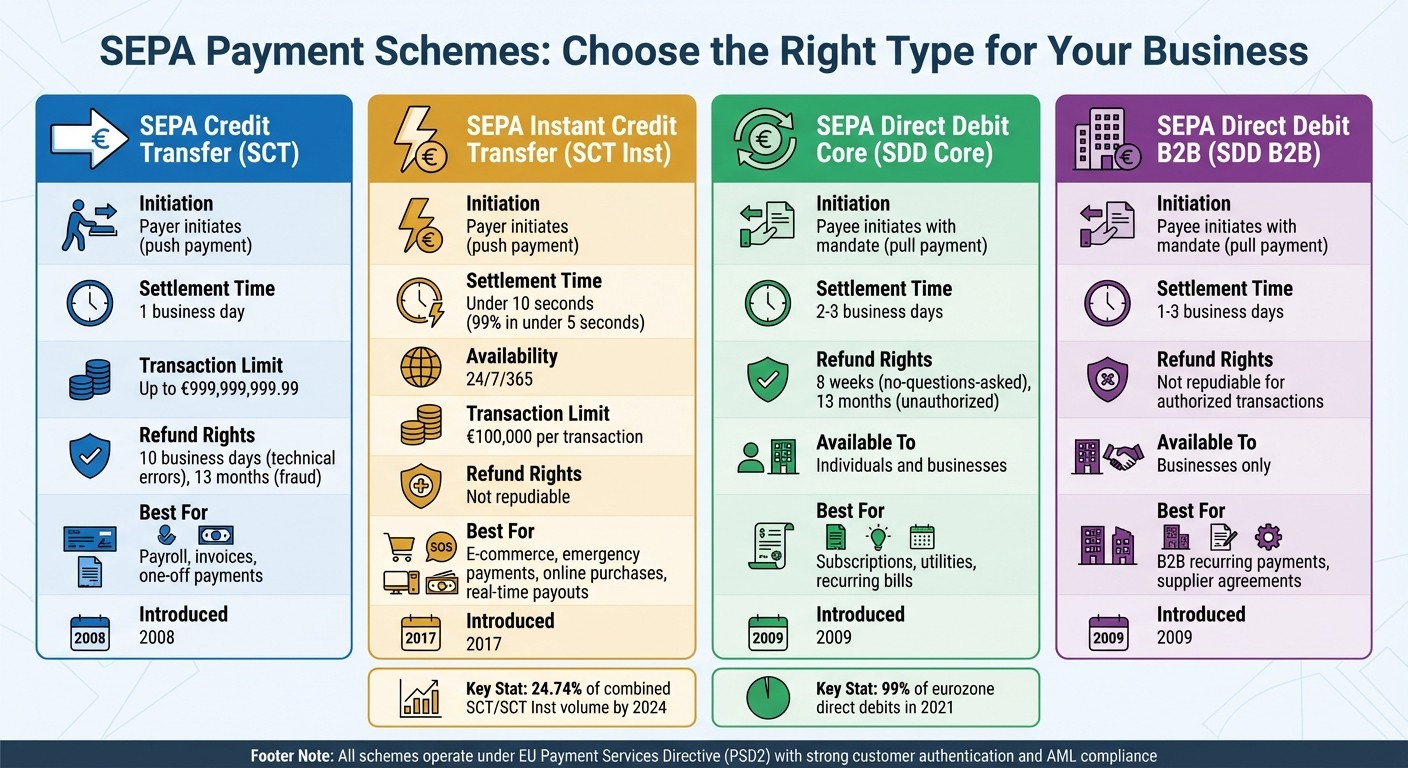
SEPA Payment Types Comparison: SCT, SCT Inst, SDD Core, and SDD B2B
SEPA Schemes Explained
The European Payments Council oversees four main SEPA payment schemes, each suited for specific transaction types. SEPA Credit Transfer (SCT), introduced in 2008, is designed for push payments where the payer initiates the transaction. This includes uses like salary disbursements, invoice payments, or one-time money transfers. SCT transactions are processed within one business day.
SEPA Instant Credit Transfer (SCT Inst) was launched in 2017 to enable real-time payments. These transfers are completed in under 10 seconds and operate 24/7, every day of the year. Impressively, over 99% of these transactions are settled in less than five seconds. With the EU's Instant Payments Regulation, adopted in March 2024, all banks are required to support instant payments by early 2025 - covering incoming payments by January and outgoing payments by October. By that time, instant transfers made up 24.74% of the total combined volume of SCT and SCT Inst transactions.
For recurring payments, there are two direct debit schemes: SEPA Direct Debit Core (SDD Core) and SEPA Direct Debit B2B (SDD B2B), both introduced in 2009. These allow payees to collect payments directly from customers' accounts, provided they have prior authorization through a mandate. SDD Core is available to both individuals and businesses, with processing times of 2–3 business days. SDD B2B, on the other hand, is exclusively for business-to-business transactions and processes within 1–3 business days. Notably, in 2021, 99% of all direct debits in the eurozone were processed under the SDD Core scheme.
To better understand these schemes, let’s compare their features side by side.
SEPA Payment Types Compared
The primary differences between SEPA schemes lie in how payments are initiated, their processing speed, and refund policies. SCT and SCT Inst are "push" payments, meaning the payer decides when and how much to transfer. In contrast, direct debits are "pull" payments, where the recipient withdraws funds based on a pre-approved mandate.
Feature | SCT | SCT Inst | SDD Core | SDD B2B |
|---|---|---|---|---|
Initiation | Payer initiates | Payer initiates | Payee initiates with mandate | Payee initiates with mandate |
Settlement Time | 1 business day | Under 10 seconds | 2–3 business days | 1–3 business days |
Refund Rights | 10 business days (technical) and 13 months (fraud) | Not repudiable | 8 weeks (no-questions-asked) and 13 months (unauthorized) | Not repudiable for authorized transactions |
Best For | Payroll, invoices, one-off payments | E-commerce, emergency payments, online purchases | Subscriptions, utilities, recurring bills | B2B recurring payments, supplier agreements |
Source:
Knowing these differences can help you choose the right scheme for your specific needs. For example, SCT is ideal for routine vendor payments, while SCT Inst is perfect for urgent transactions like on-demand salary advances or real-time insurance payouts. Direct debits, on the other hand, are great for managing recurring payments, with SDD B2B offering added finality since authorized transactions cannot be refunded.
How SEPA Transfers Work
SEPA Transfer Process
The process for a SEPA transfer is fairly simple and begins with your bank's online platform or mobile app. Start by selecting euros as the currency and entering the recipient's full name and IBAN. Some banking systems might automatically fill in the BIC for you.
Next, input the amount you wish to send and include a payment reference if needed. Double-check all the details before authorizing the payment using your PIN, a one-time password, or another security method. Once approved, your bank debits your account and sends a SEPA message. The funds are then transferred directly or through an intermediary to the recipient's bank, which credits their account.
For direct debits, the process is slightly different. You must approve a mandate that allows the recipient to initiate payments. The recipient's bank will submit a collection request at least five interbank working days before the first payment - or two days for recurring payments under SEPA Core Direct Debit. For business-to-business payments, the request must be submitted at least one day in advance. Once the transfer is initiated, it's important to understand how long it will take and what it will cost.
Processing Times and Costs
SEPA Credit Transfers are typically completed within one business day. If you're using SEPA Instant Credit Transfers, the funds settle in less than 10 seconds, and these transfers are available 24/7, even on holidays.
One of SEPA's biggest advantages is its fee structure. Thanks to EU regulations, banks must charge the same fees for cross-border euro transfers as they do for domestic ones. For example, sending €500 to another European country costs the same as transferring it locally. Many banks even offer free or low-cost SEPA transfers, making them a cost-effective alternative to traditional international wire transfers.
Required Data and Account Information
To ensure a successful SEPA transfer, you'll need to provide the recipient's full name, IBAN, and occasionally their BIC. The IBAN acts as a unique identifier for the recipient's bank account. While the SEPA IBAN-only rule has removed the need for a BIC in most cross-border transactions, some banks may still require it.
Starting in 2025, a new regulation under the Instant Payments Regulation will require payment providers to verify the recipient's name against the IBAN. This measure aims to reduce fraud and prevent payments from being sent to the wrong account. Additionally, businesses that don't have bank accounts within the EU can still make SEPA transfers through payment service providers, avoiding the need to open a separate account just for these transactions.
These streamlined processes not only maintain the reliability of traditional SEPA payments but also enable seamless integration with Bitcoin and other modern payment infrastructures.
Compliance, Limits, and Risk Management
SEPA Regulatory Framework
The SEPA system is built on a solid legal foundation that ensures secure and transparent transactions. Two key regulations, the Cross-border Payments Regulation and the Payment Services Directive (PSD2), play a central role in defining rules around transparency, security, and consumer rights. These regulations require banks and payment service providers to implement strong customer authentication measures and provide detailed transaction information.
Additionally, the EU's anti-money laundering (AML) directives mandate strict customer checks, continuous payment monitoring, and measures to block transactions linked to financial crimes. This regulatory framework not only safeguards transactions but also enables the integration of traditional and digital payment systems. These rules apply uniformly to all payment service providers facilitating euro transfers within the SEPA zone, ensuring consistent protections across the 41 participating countries. Together, these regulations establish the groundwork for SEPA's transaction limits and risk management practices.
Transaction Limits and Geographic Coverage
SEPA payment limits depend on the type of transfer being made. For SEPA Credit Transfers, the maximum limit is an enormous €999,999,999.99, making them ideal for large-scale business transactions. SEPA Instant Credit Transfers, on the other hand, are capped at €100,000 per transaction, though individual banks often impose lower limits based on customer profiles.
For instance, some banks set default limits, such as €15,000 for individual users and €100,000 for business entities, which customers can adjust if needed. SEPA Direct Debits don’t have a universal limit across the scheme, but payment service providers typically enforce their own caps. For example, Stripe limits individual transactions to €10,000 and imposes a weekly cap of €10,000 for new users, which can increase as users process more payments.
The SEPA zone spans 41 countries, including all EU member states, as well as Iceland, Norway, Liechtenstein, Switzerland, Monaco, San Marino, Andorra, Vatican City, and the United Kingdom. These geographic and operational parameters are further reinforced by fraud prevention measures, ensuring secure and efficient transactions.
Fraud Prevention and Risk Controls
SEPA's security framework is bolstered by advanced fraud prevention mechanisms. Payment service providers employ strong customer authentication, requiring multi-factor verification methods like PINs, mobile devices, or biometric data such as fingerprints. Transactions are also subject to AML screening, which automatically flags any suspicious activity. These measures ensure that all parties are protected without compromising SEPA’s hallmark efficiency and speed.
Integrating SEPA with Bitcoin and Lightning Infrastructure
Using SEPA for Bitcoin and Lightning Transactions
SEPA's efficiency in handling euro payments has now been extended to digital assets, creating a connection between traditional banking and cryptocurrency. These integrations enable automated systems to seamlessly convert SEPA euros into Bitcoin and vice versa, making transactions smoother and more efficient. Companies are taking advantage of SEPA's low fees and combining it with the Lightning Network's instant settlement capabilities to simplify cross-border payments.
A flexible, multi-channel approach further enhances this system. For instance, businesses can convert SEPA payments into euro-backed stablecoins, transfer them across blockchain networks, and cash them out as euros at their final destination. This adaptability ensures businesses have multiple options for managing their funds.
How Comet Cash Simplifies SEPA Integration
Comet Cash offers a streamlined, non-custodial way to integrate SEPA with Bitcoin and Lightning operations. Through user-friendly APIs and dashboards, businesses can link their SEPA euro accounts with Lightning nodes and Bitcoin addresses, enabling smooth workflows between traditional banking and blockchain systems.
With real-time payment processing, Comet Cash allows companies to accept SEPA transfers and automatically convert them into Bitcoin or route them through the Lightning Network - eliminating the need for manual steps. Features like team-controlled nodes, customizable channel settings, and developer tools (SDK and CLI) simplify the reconciliation process between SEPA payments and digital asset settlements.
Business Workflow: Step-by-Step Guide
Connect Banking Details: Link your euro banking information (IBAN, BIC) to the Comet Cash API.
Set Lightning Parameters: Use the dashboard to configure Lightning node settings, such as channel capacity and routing preferences.
Automate Actions: Once SEPA payments are received, the platform can automatically execute actions like purchasing Bitcoin at market rates, opening Lightning channels, or settling invoices.
Track Transactions: Use the reconciliation dashboard to log key details like timestamps, exchange rates, and transaction IDs for audit purposes.
With the ability to adjust routing rules in real time, businesses can optimize each transaction, whether dealing with large payments or micropayments that benefit from lower fees. This flexibility ensures efficient and cost-effective operations.
Conclusion
SEPA has revolutionized the way businesses manage euro-denominated payments across Europe, handling an impressive 50 billion transactions each year. By simplifying cross-border payments to feel as seamless as domestic ones, SEPA reduces complexity and costs while maintaining strict security protocols, such as those mandated by PSD2.
For businesses working within European markets or dealing with euro payments, SEPA offers clear advantages. Predictable costs, faster settlements, and standardized processes make tasks like payroll and supplier payments far easier to manage. The use of standardized identifiers helps minimize errors, and the elimination of intermediary fees within the eurozone translates into tangible savings. With 99% of instant credit transfers completed in under five seconds, SEPA also stands out for its speed and reliability. This efficiency integrates smoothly into digital workflows.
Now, with the integration of SEPA into Bitcoin and Lightning Network infrastructure, new opportunities emerge for connecting traditional banking systems with digital assets. SEPA's streamlined processes pair effectively with the Lightning Network, offering businesses a more efficient way to manage cross-border payments and cryptocurrency transactions.
Comet Cash takes this integration a step further, providing a non-custodial system that links SEPA euro accounts directly to Lightning nodes and Bitcoin addresses. This setup allows businesses to automate currency conversions, optimize routing in real time, and maintain complete control over their funds, whether for large transfers or micropayments.
With its established framework, SEPA ensures secure and cost-effective transactions across 41 European countries. When combined with forward-thinking tools like Comet Cash, businesses can operate across borders efficiently while staying aligned with emerging payment technologies.
FAQs
How does SEPA keep cross-border transactions secure?
SEPA prioritizes the security of cross-border transactions by adhering to stringent European regulations, such as the Payment Services Directive (PSD/PSD2) and the SEPA Regulation. These regulations establish rigorous standards for authentication, data protection, and fraud prevention.
To meet these standards, banks and payment service providers implement advanced security measures like secure PINs, strong passwords, biometric verification, and encryption. These tools work together to protect sensitive data and ensure that funds move securely across borders.
What is the difference between SEPA Credit Transfers and SEPA Direct Debits?
SEPA Credit Transfers and SEPA Direct Debits are two primary methods for moving money within the Single Euro Payments Area (SEPA). While both serve the purpose of facilitating payments, they operate differently and are suited to distinct needs.
SEPA Credit Transfers are ideal for one-time payments. These are initiated by the payer (the person sending the money) and are typically completed within a single business day. With a transaction limit of up to €999,999,999.99, they are versatile enough for both personal use and large-scale business payments.
SEPA Direct Debits, in contrast, are designed for recurring payments, such as monthly utility bills or subscription services. In this case, the payee (the person or business receiving the money) initiates the transaction, but only after obtaining the payer’s authorization through a mandate. Processing times for these transactions usually range from 2 to 3 business days.
To put it simply, SEPA Credit Transfers are push payments initiated by the sender, while SEPA Direct Debits are pull payments initiated by the recipient, with the payer’s prior consent.
How can businesses use SEPA transfers with Bitcoin payments?
Businesses looking to combine SEPA transfers with Bitcoin payments can partner with payment service providers (PSPs) that handle both euro-based SEPA transactions and cryptocurrency processing. These PSPs typically offer tools like APIs, enabling businesses to accept Bitcoin, convert it to euros, and settle payments seamlessly through SEPA transfers.
This approach makes cross-border transactions within Europe more straightforward while adhering to AML and KYC regulations. By integrating SEPA banking systems with crypto wallets, businesses can effectively manage fiat-to-crypto conversions and simplify their payment workflows.