
Why mobile gaming microtransactions are perfect for the Lightning Network

Comet Cash Team
•
Dec 17, 2025
Mobile games thrive on small purchases - like $0.10 power-ups or $0.50 retries - but outdated payment systems struggle to support these tiny transactions. High fees, slow processing, and fraud risks make traditional methods inefficient. The Lightning Network solves this by enabling instant payments with fees that are just fractions of a cent.
Here’s why the Lightning Network works so well for mobile gaming:
Low Costs: Fees are negligible, even for purchases under $1.
Speed: Transactions complete in milliseconds, ensuring instant access to in-game items.
Scalability: Can handle millions of transactions per second to support games with large player bases.
Security: Built on Bitcoin, it prevents fraud and chargebacks, saving developers billions annually.
Global Reach: Supports cross-border payments without conversion fees or delays.
This technology allows developers to create flexible pricing models, reward players with Bitcoin, and build dynamic in-game economies. Tools like Comet Cash make it easy to integrate Lightning payments, providing a simple, secure way to handle microtransactions at scale.
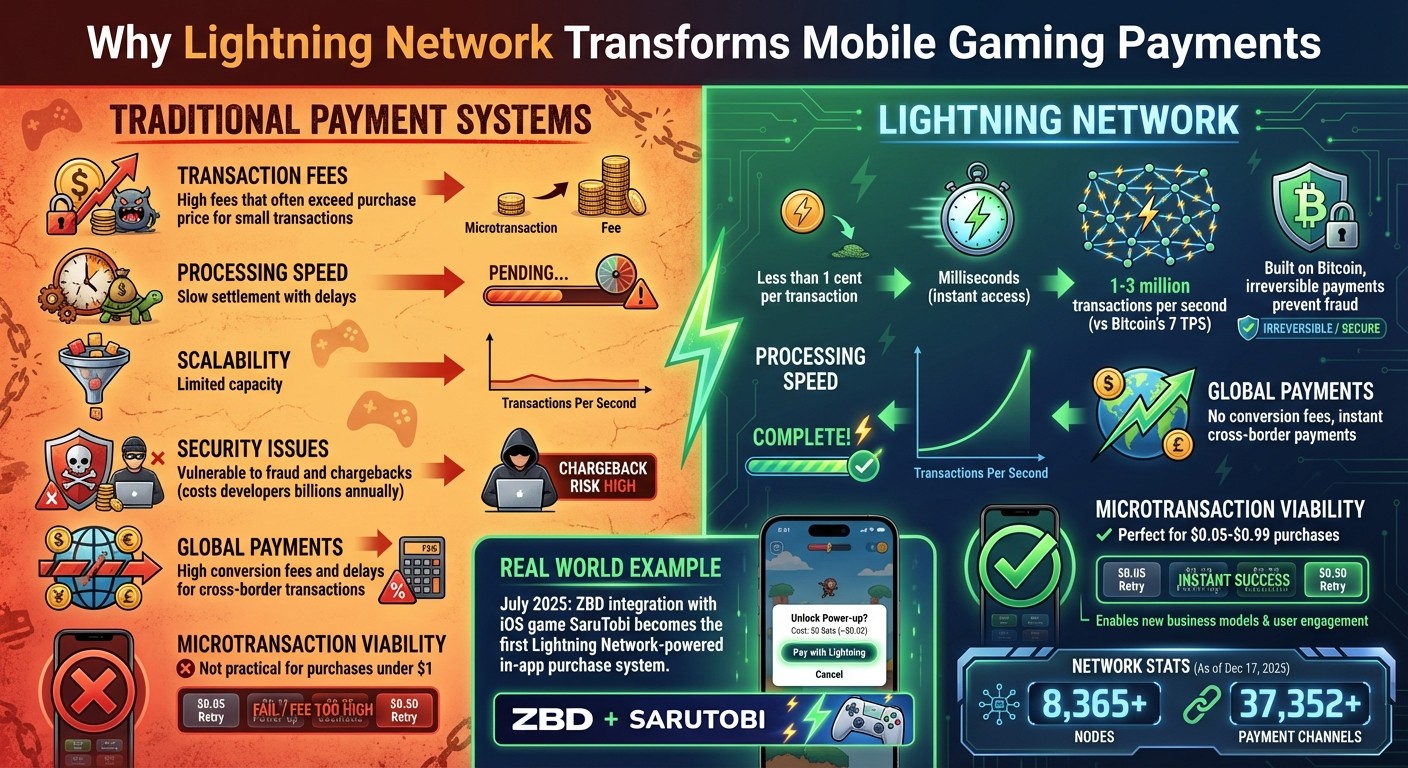
Lightning Network vs Traditional Payment Systems for Mobile Gaming Microtransactions
What Can the Bitcoin Lightning Network Do For Web3 Gaming?
How the Lightning Network Works for Mobile Gaming
The Lightning Network is a Layer 2 protocol built on top of Bitcoin's blockchain, designed to tackle Bitcoin's scalability challenges for everyday transactions. Instead of processing every transaction directly on Bitcoin's main blockchain - which can be slow and costly - the Lightning Network shifts transactions off-chain using secure channels. These channels allow players and game developers to exchange value instantly, creating a fast and cost-effective system for handling microtransactions in mobile games. Let’s dive into the key components that make the Lightning Network a great fit for mobile gaming.
Lightning as a Layer 2 Payment Solution
At the heart of the Lightning Network are payment channels, which enable quick and efficient in-game transactions. When two parties open a channel, they create a multi-signature wallet that requires approval from both sides before funds can be moved. Within these channels, players can make countless small-value transactions without each one being logged on the blockchain. Only the opening and closing of the channel are recorded on-chain. This approach keeps transaction costs low, making even the tiniest microtransactions feasible for mobile gaming.
Features That Appeal to Game Developers
For game developers, the Lightning Network offers a practical solution by utilizing satoshis (sats) - the smallest unit of Bitcoin, where 100 million sats equal one Bitcoin. This allows developers to price in-game items at various levels, from tiny power-ups to premium content. The network also uses routing nodes to connect channels, ensuring smooth transactions between users, even if they aren’t directly linked. Security features like Hashed Timelock Contracts (HTLCs) ensure that transactions are completed fully or not at all, while onion routing encrypts payment paths to safeguard player privacy. With these features, the Lightning Network not only facilitates seamless payments but also enhances security and decentralization in gaming.
Security and Decentralization Advantages
The Lightning Network builds on Bitcoin's strong security foundation while enabling real-time, trustless payments. As one expert puts it, "It's built on Bitcoin's existing security model, using smart contracts to ensure trustless payments". Since the network is non-custodial, players maintain full control over their funds, meaning no third party can freeze accounts or seize assets. Its peer-to-peer structure allows anyone to run a Lightning node, reducing reliance on centralized systems. Additionally, payments are irreversible, which minimizes the risk of chargebacks and fraud. As another expert notes, "Bitcoin was built to be secure and decentralized, not to work fast. Still, due to the Lightning Network and similar solutions, it doesn't have to slow down to preserve those core principles". These qualities make the Lightning Network a reliable choice for mobile games, offering secure and fraud-resistant microtransactions.
Why Lightning Network Matches Mobile Gaming Microtransactions
Problems with Traditional Payment Systems
Traditional payment systems struggle to keep up with the needs of mobile gaming microtransactions. Imagine trying to buy a $0.50 power-up or a $0.10 cosmetic item - credit card networks and other platforms often tack on fees that can actually exceed the purchase price. On top of that, delays in settlement can frustrate players who expect instant access to their purchases. Reversible payment methods like ACH and credit cards also expose game developers to risks like fraud and chargebacks, adding an extra layer of complexity and cost to the process. These inefficiencies highlight the need for a better solution.
Lightning's Benefits for Microtransactions
The Lightning Network addresses these challenges head-on. With transaction fees often costing less than a cent , even the tiniest purchases become practical. For instance, a player can grab a $0.05 retry or a $0.25 cosmetic item without worrying about fees eating into the value. Payments are processed in mere seconds, ensuring players get what they want right away . While Bitcoin’s main blockchain can only handle around 7 transactions per second, the Lightning Network has the capacity to process millions of transactions per second.
A great example of its potential came in July 2025, when ZBD integrated Bitcoin microtransactions into the iOS game SaruTobi. Players could pay for individual actions like retries or power-ups directly, bypassing traditional in-app purchase systems. Even better, they could use Bitcoin rewards earned in-game to make these purchases, creating a lively and self-contained economy. This approach not only makes microtransactions more accessible but also enriches the gaming experience.
Better Player Experience
With the Lightning Network, players gain more control over their spending through pay-as-you-go models. Instead of being forced to buy $4.99 bundles they might not fully use, they can pay only for what they need. Plus, they can instantly spend small Bitcoin rewards earned in-game . This creates a dynamic in-game economy where virtual accomplishments translate directly into purchasing power.
The network’s ability to enable fast, low-cost transfers of small amounts makes it a perfect fit for microtransactions that traditional systems can’t handle efficiently. By removing the friction and hesitation often tied to small purchases, the Lightning Network opens up new opportunities for developers to monetize their games while giving players a seamless and flexible experience. It’s a win-win for everyone involved.
Lightning Network Use Cases in Mobile Gaming
New In-Game Purchase Models
The Lightning Network opens up possibilities for purchase models that traditional systems just can't handle. For instance, microtransactions become a breeze - players can purchase single in-game items like an extra life or a retry for mere cents, without worrying about fees cutting into the value. Another option? Time-based payments, where gamers pay for each session or even by the minute they play.
It also introduces peer-to-peer payments in gaming. Take Satoshi's Games, for example. They’ve developed a toolkit called Elixir that lets developers integrate Bitcoin and create marketplaces for in-game assets. Using technologies like the Liquid sidechain, the Lightning Network, IPFS, and L-SATs, Elixir supports decentralized trading of Bitcoin-based NFTs. These payment models naturally evolve into dynamic reward systems, giving players even more reasons to engage.
Reward Systems and In-Game Economies
Lightning Network makes instant payouts in satoshis seamless for activities like achievements, daily quests, or tournaments. A great example is THNDR Games, which uses lotteries where players collect tickets to win Bitcoin prizes. Winners can cash out instantly using Lightning-enabled wallet apps. By 2025, platforms like Zebedee are taking this further, rewarding players in real time with microtransactions that offer actual value for their in-game milestones.
Players can earn small amounts of Bitcoin for completing tasks and immediately use these rewards to buy in-game items or withdraw them. This not only enhances the gaming experience but also minimizes operational hurdles. These systems keep players coming back while creating thriving in-game economies that practically run themselves.
Cross-Border Payments and Global Access
The Lightning Network also simplifies global payments, making it perfect for games with players from all over the world. Unlike traditional systems that charge hefty conversion fees and delay settlements, Lightning payments are instant and hassle-free. For instance, Strike uses the Lightning Network for international remittances, allowing users to send money quickly and affordably.
"Lightning payments are borderless and currency-agnostic, making them ideal for international user bases." - ElenPAY
This means developers can enable cross-border transactions for in-game purchases without worrying about exchange rates or extra fees. Payments are completed in seconds at almost no cost, which is especially beneficial in underbanked regions where remittance fees are steep.
Integrating Lightning Network with Comet Cash
Comet Cash takes the benefits of the Lightning Network and makes them accessible for mobile game developers. By offering a plug-and-play solution, the platform eliminates the need for developers to build their own infrastructure from the ground up. Instead, Comet Cash provides real-time, non-custodial Bitcoin and Lightning payment capabilities through APIs, SDKs, and user-friendly management dashboards - streamlining the process for businesses that need reliable payment systems.
Tools Tailored for Game Developers
Comet Cash equips developers with a comprehensive set of tools for managing Lightning nodes and payment channels. Through its intuitive dashboard, developers can oversee operations, while SDK and CLI options allow for customization of channel settings and node configurations. This means studios can focus on crafting engaging gameplay, leaving the technical intricacies of payment integration to Comet Cash.
The platform also includes team-based node control, enabling collaborative management - a crucial feature for studios that regularly update their games. Plus, its non-custodial design ensures developers maintain full control over their Bitcoin infrastructure, offering a flexible and secure foundation for cross-border payment solutions.
Real-Time Payments and Global Flexibility
Comet Cash supports instantaneous Bitcoin payments via the Lightning Network, while also enabling fiat-to-crypto integrations. Developers can display prices in U.S. dollars or other fiat currencies, with transactions settled seamlessly using Lightning. Additionally, the platform supports stablecoin issuance and fiat-crypto conversions, giving developers more options to design dynamic in-game economies.
For international games, this means players can make purchases instantly, regardless of location, while developers receive payments in their preferred format - whether that's Bitcoin, stablecoins, or traditional fiat currencies.
Secure and Scalable Operations
When it comes to microtransactions in mobile gaming, security and efficiency are non-negotiable. Comet Cash's non-custodial and encrypted infrastructure ensures payment data remains secure during every transaction.
The platform is also built to scale effortlessly, whether you're a small indie developer or a major studio. It adapts to fluctuating demands, handling both peak traffic during major events and steady day-to-day operations with ease.
Best Practices for Lightning Payments in Mobile Gaming
The Lightning Network offers both technical and economic advantages for mobile gaming, but leveraging its potential requires careful planning. To create a smooth gaming experience, developers need to balance technical efficiency with user-friendly design, adhere to legal requirements, and ensure stable performance even under challenging mobile network conditions.
Designing a Simple Payment Experience
One major hurdle is making payments effortless for players. Gamers aren’t interested in the technical details of Bitcoin nodes or payment channels - they just want to buy a power-up or unlock a level without any hassle.
A straightforward approach is to display prices in U.S. dollars while handling transactions through the Lightning Network in the background. For example, players would see familiar amounts like $0.99 or $2.49, while the system processes the payment instantly using Bitcoin. This eliminates the need for players to understand cryptocurrency, delivering the benefits of speed and low costs without adding complexity.
Another key step is integrating WebLN into the game interface. This allows secure connections to users' Lightning nodes for payments without interrupting gameplay. The result? A seamless transaction process that feels as natural as any other in-game purchase.
A great example of this is ZBD’s integration of Bitcoin microtransactions into the iOS game SaruTobi in July 2025. This marked the first time an iOS game used Lightning Network–powered in-app purchases. The success of this implementation showed that Lightning payments could fit within Apple's ecosystem when paired with user-centric design.
For wallet functionality, include key features like a balance checker, channel manager, and transaction history, all presented in a simple, intuitive layout. Push notifications, offline monitoring, and background syncing can further enhance the experience, ensuring smooth performance even when players are not actively engaged.
Once the user experience is optimized, the next step is addressing compliance and operational requirements.
Compliance and Platform Policies
Staying compliant with regulations is non-negotiable. For instance, the U.S. Financial Crimes Enforcement Network (FinCEN) requires payment systems handling currency or digital assets to comply with anti-money laundering (AML) rules. Developers should implement Know Your Customer (KYC) procedures tailored to transaction volumes and user behavior patterns.
Regulatory shifts like the SEC’s repeal of Staff Accounting Bulletin (SAB) 121 through SAB 122 have reduced obstacles for Bitcoin payment infrastructure, reflecting broader institutional acceptance. At the same time, platform policies are evolving. Legal decisions such as the Digital Markets Act (DMA) in Europe and the Epic v. Apple case in the U.S. are pushing companies like Apple and Google to rethink restrictions on alternative in-app payment systems.
Once compliance is addressed, the focus shifts to ensuring reliable performance for uninterrupted transactions.
Performance and Reliability
Lightning transactions need to work seamlessly even when mobile networks are unstable. Players often switch between Wi-Fi and cellular data, and payment systems must handle these interruptions gracefully.
The Lightning Network’s capacity - capable of handling 1–3 million transactions per second - far surpasses Bitcoin’s main chain (around 7 transactions per second). However, real-world performance depends on having open and well-connected payment channels between the game and its players. As of December 17, 2025, the Lightning Network boasts over 8,365 nodes and more than 37,352 payment channels, providing a strong foundation for gaming applications.
To ensure smooth transactions, implement node monitoring to track invoice statuses and enable automatic retries. This minimizes disruptions by catching failed payments early, without requiring players to intervene.
For high-demand situations, such as limited-time events or new content launches, consider minting in-game items onto Layer 2 sidechains instead of processing everything through Lightning channels. This allows players to access their purchases instantly and enables free transfers between users, avoiding congestion during peak activity.
Finally, automated liquidity solutions can help maintain sufficient funds in payment channels, reducing the risk of transaction failures caused by capacity issues. Strengthened routing protocols further ensure payments find clear paths from players to the game’s Lightning node, enhancing reliability even in high-traffic scenarios.
Conclusion
The Lightning Network addresses some of the biggest hurdles in mobile gaming microtransactions. Traditional payment systems often falter when handling frequent, low-value transactions, burdening developers with hefty fees and frustrating delays. Lightning changes the game with instant settlements and minimal transaction costs. Its irreversible payments also tackle chargeback fraud, significantly reducing industry losses.
For players, Lightning offers the convenience of near-instant purchases and the ability to make cross-border payments without worrying about currency conversions. Its scalability - capable of handling millions of transactions seamlessly - ensures even the most popular games operate without performance hiccups.
This efficiency opens the door to monetization models that were once out of reach. Developers can now introduce pay-per-use features, provide instant payouts for small winnings, and reward players in real time - all without the overhead of high transaction fees.
To make this technology accessible, Comet Cash simplifies Lightning Network integration. With its user-friendly APIs, SDKs, and dashboards, developers can incorporate Lightning payments into their games as easily as any other payment system. More importantly, it allows developers to retain full control over their infrastructure while leveraging Lightning's real-time, non-custodial Bitcoin capabilities.
The synergy between Lightning's technical strengths and Comet Cash's developer-friendly tools is reshaping mobile gaming. Together, they make true micropayments possible at scale, enabling sustainable business models and enhancing player experiences around the globe.
FAQs
How does the Lightning Network keep mobile gaming microtransactions secure?
The Lightning Network provides a secure way to handle mobile gaming microtransactions through encrypted payment channels powered by Bitcoin's smart contract technology. This design ensures transactions are both trustless and irreversible, offering protection for both players and developers.
To combat fraud or unauthorized activities, the Lightning Network integrates penalty mechanisms and optional tools such as watchtower services. These tools actively monitor payment channels, helping to prevent breaches and maintain a safe, smooth gaming environment.
How does Comet Cash make it easier to use Lightning payments in mobile games?
Comet Cash makes it easy to add Lightning payments to mobile games, offering low fees, instant transactions, and strong security. This is ideal for managing frequent, low-cost in-game purchases like power-ups or character skins without delays or high costs eating into profits.
By integrating Comet Cash, developers can elevate the gaming experience with smooth microtransactions that work anywhere in the world, even across borders. Plus, it helps cut down on operational costs, making it a flexible option built to handle the fast-moving world of mobile gaming.
How does the Lightning Network make mobile gaming more enjoyable?
The Lightning Network brings a new level of convenience to mobile gaming by offering instant and low-cost transactions. This means in-game purchases and microtransactions can happen quickly and without the frustration of high fees or delays, creating a smoother experience for players.
Beyond speed and affordability, the Lightning Network also provides a more secure and scalable payment system. Developers can use this to introduce exciting features like real-time rewards or seamless cross-border transactions, all without being bogged down by excessive costs or lag. It’s a win-win for players and developers, streamlining every transaction and enhancing the overall gaming experience.